Saturday, December 25, 2004

Irish Arts Lecture

Liam Kelly, senior lecturer of art and design at the University of Ulster, Ireland, will present a lecture titled "Northern Irish Art: Acts of Interrogation" at 3 p.m. Monday (March 5) in Room 119 of DeBartolo Hall at the University of Notre Dame.
The lecture, which is sponsored by the Keough Institute for Irish Studies, is free and open to the public.
Kelly, who earned his doctorate from Trinity College, Dublin, is an expert on contemporary Irish art. He has served on the Visual Arts Committee of the Arts Council in Northern Ireland, and as vice president of the International Association of Art Critics in Paris.
Irish Art

Picasso Pottery in London

Lord Attenborough will present his Picasso pottery collection in Leicester at the New Walk Museum and Gallery in July 2005. The collection was amassed over a 50 year period. It showcases familiar Picasso themes such as Mediterranean scenes, still life and bullfights.
Irish Art

50 Years of Twombly

The enigmatically poetic oeuvre of one of the greatest living artists in America is celebrated in Cy Twombly: Fifty Years of Works on Paper, at the Whitney Museum of American Art from January 27 - May 8, 2005. Using a variety of materials and methods including paint, crayon, and collage.

Twombly continues to create a remarkably cohesive body of work that takes its inspiration from a vast array of sources, embracing everything from ancient mythology, epic poetry and the great battles of classical history to nature.
For the full story - click the title

Sculptor Anne Truitt Dies

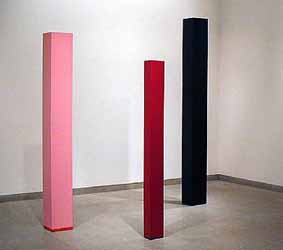
For 40 years, Anne Truitt was a major figure in American art, famous for her graceful, richly painted minimalist sculptures of vertical blocks of wood. The blocks, standing 5 to 7 feet high, with coat after coat of acrylic paint, acquired a mesmerising, translucent visual intensity. Her rectangular sculptures were painted in subtle, precisely shaded colors set on slightly recessed bases and appear to hover just above the floor.

Her eyesight as a child was so poor when that until she got glasses, she didn't realize trees had individual leaves. She saw them as large masses of color and form. "I've struggled all my life to get maximum meaning in the simplest possible form" she once wrote.
Truitt is in the permanent collections of many leading museums, including the National Gallery of Art, the Metropolitan Museum of Art and the Whitney Museum of Art in New York.

Royal Art Supremo

Desmond Shawe-Taylor, director of the Dulwich Picture Gallery in London since 1996, has been appointed Surveyor of the Queen's pictures. Mr. Shawe-Taylor succeeds Christopher Lloyd, who is retiring in July. When he starts his new job in April, Mr. Shawe-Taylor will have curatorial responsibility for 7,000 oil paintings and 3,000 miniatures on display at the principal royal residences, which are all open to the public.
The new Queen's Galleries at Buckingham Palace, the Palace of Holyrood House in Edinburgh and the Drawings Gallery at Windsor Castle have exhibition programs showing different parts of the collection to the public.
Irish Art

Friday, December 24, 2004

Suspect held on Munch Robbery

Norwegian police have interrogated a 37 year old suspect in last summers robbery of the "The Scream" and "Madonna" by world-renowned artist Edward Munch. Oslo police said the man was a suspect and, although released, was "still a suspect".

"The Scream", one of the most famous images ever painted, and "Madonna" were grabbed last August by armed, hooded gunmen in broad daylight from the Munch Museum in Oslo. The two paintings are still missing, and quoted criminal sources suggested that the paintings may have been damaged in the daring robbery.
Experts said the paintings are too famous to be resold, and will probably be used as insurance ransom for their 10 million pound value.

Thursday, December 23, 2004

Aussie $100,00 Art Prize

A relatively unknown artist from Melbourne has won the richest art prize in Australia.
Prudence Flint won the Doug Moran National Portrait Prize, collecting $100,000 prize money. Ms Flint was chosen from 30 finalists for her work called A fine romance number nine.
Ms Flint says was shocked by the win. "Because my painting is not really a classic portrait at all and so I wasn't really expecting to, so that's why I am really thrilled," she said.
She says historically women have been painted as objects in the past, so she has deliberately painted the abstract of herself in a modern context.
"I wanted the woman to look really kind of occupied and doing something very modern and important so because I think it is very much what women do these days is they work hard," Ms Flint said.
Ms Flint says she plans to buy a house, a laptop computer and build a studio with her prize money.

Art Fakers v The Computer

Art historians have long used scientific tools to decide whether artworks are real or fakes - counting isotopes in lead-based paints and shining X-ray and infrared radiation on oil portraits to discover what lies beneath.
Now researchers at Dartmouth College have fed digitally scanned artworks into a computer and then used image-processing techniques to create statistics describing the pen and brush strokes. The computer analysis detects subtle differences in these strokes that help distinguish an artist from an imitator.
The scientists tried it out on drawings by Pieter Bruegel the Elder, the Flemish master. The computer program agreed with the Bruegel experts, grouping eight drawings attributed to Bruegel in one category and assigning the imitations to a separate pile.
Irish Art

Canadian Stolen Art Saga

A Canadian family scored a major legal victory when a judge in the Czech Republic agreed that they should gain possession of a collection of Klimt, Ensor, Liebermann and Kokoschka paintings worth millions of dollars despite delaying tactics by the Czech authorities.
The Federer family sued two small public galleries in Ostrava and Pardubice to reclaim the works, part of more than 130 artworks collected by their Jewish grandfather Oskar Federer, before the start of the Second World War then later confiscated by Communists.
The Oskar Federer collection included paintings by Van Gogh, Cezanne, Renoir, Utrillo, Manet, Matisse and Derain among many others. More than half the collection - now worth tens of millions of dollars - remains unaccounted for.
Irish Art

Vermeer Studio found

The original studio of 17th-century Dutch master Johannes Vermeer has been found in Delft. Interest in Vermeer by the general public has soared since the successful movie "Girl with A Pearl Earring" was released - which fictionalised the situation that inspired the painting.
Daan Hartmann, a famous art restorer and expert on authenticating Vermeer found the studio. He had been working in it himself for last 20 years until he finally made the Vermeer connection. The studio, once hidden in an overgrown garden, is likely to become a major Dutch tourist attraction.
Irish Art

The Future of Irish Art?

A number of French-inspired masterpieces from budding Ulster in Bloom artists in Londonderry have arrived through the doors at the Translink Belfast Central Station, making the 2004 schools art competition the best ever, according to the organisers.
Now in its fourth year, the Ulster in Bloom Schools Art Competition encourages pupils to be inspired by the masterpieces of French artist Henri Matisse, and has proved to be a great success with almost 70 schools from across Northern Ireland submitting entries.
Irish Art

Saatchi shark sold for six million

The Damien Hirst shark in formaldehyde is reported as being sold to a mystery US buyer for 6.2m pounds in a deal to be finalised early in the new year.
Charles Saatchi paid 50,000 pounds to Hirst for the work called "The Physical Impossibility Of Death In The Mind Of Someone Living" who used a shark bought in Australia 14 years ago.
It was then shown a year later in the "Young British Artists" exhibition and caused interest and controversy.
Irish Art

Wednesday, December 22, 2004

The Deal of the Art

Want to invest in art without all the risk? Partner with an art dealer.
A municipal bond derivatives salesman by trade, William Zachary has a costly hobby, fine art, that could pay for itself. In addition to buying things to put on his wall he also buys art to hang on a dealer's wall. If the dealer sells at a profit, Zachary shares the loot.
Zachary is among a pool of investors who back art dealer Mark Murray. Members of this investor pool also happen to be clients of Murray's gallery.
A typical contract for funding an art dealer gives investors a two-to-three-year time frame. Alas, they can't expect a profit share in proportion to their capital contribution. The dealer must be paid for his expertise and having the piece authenticated, given a clear title, repaired and reframed. Often the dealer is compensated for this work by being paid 50% or more of the net after expenses. Another approach: Passive investors put up all the cash while the dealer pays expenses of restoration, shipping and the like. After both parties are reimbursed, any profit or loss is split equally. Fairbanks' investors usually contribute half of the money; he makes up the rest. When the art is sold, expenses come off the top; investors get 30% of the profit.
For the full story - click the title
Irish Art

Sitting for Lucian Freud

The Freud method is to leave areas of untouched surface visible until very late on. This is, as he characteristically put it, "because it makes it more difficult, which helps me". "Many painters," he explained further, "may like to feel that they are working on a picture that is already there. But I like to feel that every aspect of it is provisional, changeable, removable." Consequently, my portrait grew outwards from a single point - "organically" as Freud puts it.
First he does a charcoal drawing, but does not necessarily "go by" it. By Christmas, two eyes could be seen, surrounded by a patch of paint mainly representing my forehead. At Easter, the face stretched down to my chin. When the sun of early June arrived, there was just a quartet of white patches in the corners of the rectangle. But that proved deceptive. The jacket, for example, I thought would be an easy bit - after all, it just consists of plain blue cloth.
It did not prove so at all. He painted it one way; he painted it another. He changed the angle and contour of my shoulders, then altered them again, and again. The lapels were put in, taken out, put in once more. "The more paint goes on the jacket," he said thoughtfully after this had gone on for three or four sittings, "the better - to show it's different from the rest of the picture." "Sometimes," he added contentedly, "I spend weeks just painting and repainting the corner of a room."
For the rest of the story - click the title
Irish Art

Sargent Record at Auction

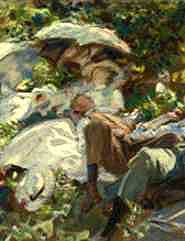
A painting by John Singer Sargent sold for 12 million pounds setting a new auction record for the artist. Group with Parasols (A Siesta) was bought anonymously at Sotheby New York.
There was speculation that the buyer was Bill Gates, the billionaire founder of the Microsoft computer empire. Mr Gates has built up one of the most extensive private art collections over the past decade, with works by American painters forming the core.

Five bidders competed for the painting by Sargent, who was an American citizen but lived in London for much of his life and became a fashionable portraitist of high society. The anonymous buyer, who had left a commission bid with the auctioneer William Stahl in the New York saleroom, was prepared to double the previous record paid for a Sargent in 1996.

Women Artists Anon Money

Anonymous Was A Woman Foundation has announced 10 artists selected for their 9th awards. The no strings $25,000 grant enables women over 35, at a critical juncture in their lives or careers, to continue to grow, recover from traumatic life events, and pursue their work. The name "Anonymous Was A Woman", refers to a line in the Virginia Wolf book A Room of Ones Own. The nominators and those associated with the program are un-named, and artists are unaware that they are being considered for the award. Winners are often stunned by the news.
Apart from money, the grant validates their work and their self-worth. Each year, an outstanding group of distinguished women including art historians, curators, and writers nominate artists for the award.
For more information email: anonwasawoman@aol.com
For the rest of the story - click the title
Irish Art

Guggenheim cancels Cezanne

A major Paul Cezanne exhibition scheduled to open on Feb. 10 at the Guggenheim Museum, New York has been called off because the museum could not borrow a number of the more important works of art.
The show, Cezanne: The Dawn of Modern Art, explores the painters impact on artists like Matisse, Picasso and Braque. It is currently on tour in Europe.
Irish Art

The Art of the Delicate

A visitor speaks of the Agnes Martin Gallery at the Harwood Museum of Art, Taos, Northern New Mexico.
"It is one of the most special galleries of art in America. The seven paintings are all five-feet square, and are built from horizontal lines and a pale blue wash. The room is gently lit: Natural light falls in from a conical skylight and the hardwood floor distributes the light throughout the space. A single bulb, about 40 watts worth, lights each canvas.
The paintings surrounded me; their delicateness intimidated me into silence. Even the sound of my pants rustling as I walked from painting to painting seemed intrusive. I quickly realized that the best way to experience Agnes Martin's paintings was to stand still in front of them and to allow myself to not just look at them, but to feel the experience of being in this place.
Ever since that visit, I've thought about how the key to enjoying Martin's paintings is less in looking at them and more in absorbing their presence. "This poem, like the paintings, is not really about nature," Martin once wrote. "It is not what is seen. It is what is known forever in the mind."
For more on Agnes Martin who died recently see post "Agnes Martin Dies"
Irish Art

Tuesday, December 21, 2004

Art Prices Rise

Art prices are now at their highest levels since the speculative bubble burst back in 1990. The Artprice Global Index calculated using data on repeat sales reveals that following the fall auction season in New York, art prices rose by 24.4% between January and December 2004. Taking into account fluctuations in exchange rates, the increase in euro terms was just 14% over the same period.
If prices continue to advance at the same pace as in 2004, they could well surpass November 1990 highs in November 2005, thus taking art market prices to unprecedented levels.
For full info on this plus worldwide auction prices - click the title
Irish Art

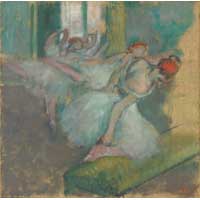
Degas: "Art in the Making"

Edgar Degas was one of the most experimental artists of the 19th century. Throughout his long career he constantly found new ways to use oil paint, chalk, pastel, essence and printmaking processes (in particular monotypes), often combining two or more media in the same work.

This exhibition is part of Art in the Making, the London National Gallery's ongoing series of exhibitions on artists' techniques, and comprises in-depth examination of some twelve works by Degas. These will be complemented by x-radiographs, infra-red reflectograms and pigment analyses, with loans of works from Britain and abroad. It will reveal to a general audience, which has long loved this artist, just how complex Degas's working methods could be. You've got until the 30th of January 2005 to take it all in.

Irish Arts Council grants up 16%

The Arts Council has been granted a 16 per cent increase in its funding for next year, but applications for funding will be almost double the 61 million euros available.
The council announced details of its funding allocation but it has yet to publish the full list of successful applicants.
Some 61 million euros in funding has been allocated to the body for 2005. The council said the 16 per cent increase will be passed on directly to artists and arts organisations. The largest increases were for the film and traditional arts sectors, which received increases of 22 per cent and 18 per cent respectively.
Some 297 organisations have been approved for funding - 39 more than last year. Of these, 18 are first-time applicants.
The successful applicants will be notified by the council later this week and the list will then be published on the Arts Council's website.
Funding programmes include artists' awards, bursaries and schemes, a minor capital scheme and a small festivals scheme.
Irish Art

Chinese Art Market

Nine days ago, China opened its doors to foreign auction houses for the first time to fulfil its obligations as a member of the World Trade Organisation.
The move ended an extraordinary year for the market in Chinese art. In Hong Kong in late October and early November, Christie's sold art and antiques totalling 35 million pounds, doubling its 2003 figures, while Sotheby's auctions soared to 42 million pounds. An anonymous Asian private buyer paid a record 515,531 pounds for the 20th-century Chinese artist Sanyu's Reclining Nude at Christie's in Hong Kong.
However, no work of art dating from before 1949 is allowed to leave the country. Christie's believe they could be holding auctions in mainland China in 10 to 15 years' time, but the restrictions on exporting works of art are simply too tight to make it viable in the short term.
Sotheby's takes a similar view and says that although it "sees China as an extraordinary opportunity for future growth", it does not "currently believe that now is the moment to hold auctions in the People's Republic of China".
The truth is that China and its new millionaires - estimated to number 235,000 already - will play an important part in the art market, but it will not be the instant boom that some people have predicted. In true Maoist style, it will be more of a long march than a quick takeover.
Irish Art

Germany fights for Rubens

Germany renewed its demand last night for the return from Moscow of a priceless Rubens oil painting that mysteriously vanished during the second world war. The Russian businessman who is refusing to give it back was threatened with legal action. The Germans have been trying to get the Rubens back since a consortium of businessmen offered it for sale last year. It disappeared in 1945 from a castle near Berlin.
The Russian businessman who now says he "owns" the painting, Vladimir Logvinenko, insists he bought it legitimately in 1999 from a Russian antiques dealer. Two months ago a court in Germany ruled that the German government had not produced enough evidence to show the Rubens was stolen.
It appears that a Russian officer acquired the painting in April 1945 as the Red Army overwhelmed Nazi Germany - possibly from a country mansion belonging to Joseph Goebbels, where it had hung in the bedroom of one of the Nazi propaganda minister's many lovers.
Art experts agree that despite its poor condition it is worth around 55 million pounds.
Earlier this year Russia's prosecutor general's office ruled that Mr Logvinenko was the Rubens' rightful owner, and said he didn't break any Russian law in acquiring it. Pieces of art stolen by Soviet troops from Germany remain a sensitive subject in Russia.
Many Russians regard them as compensation for the devastation caused by Hitler's invasion. Germany has been negotiating with Russia since 1991 for the restitution of some 200,000 artefacts, while Russia has claims on icons and other artworks stolen by German troops earlier in the war.
For the rest of the story - click the title above.
Irish Art

Irish Art in China

Irish artist Clive Murphy opens his exhibition "China OK" at the 411 Gallery, Hangzhou City, China, running until the end of December. Murphy exhibits new work created in Hangzhou over the last 3 months. He is visiting China as part of the 411 Galleries artists exchange programme funded by the Department of Foreign Affairs of Ireland and the Arts Council of Northern Ireland. Already a well known community artist in Ireland he has exhibited in the Czech Republic, the US, the UK, Germany and in Shanghai.
Murphy has also exhibited in the prestigious Ormeau Baths Gallery in Belfast. He has been working with mass produced material such as plastic and cardboard for many years and the "cheap chic" associated with such materials. The China OK exhibition uses a mix of materials and includes video and moving sculpture. The exhibition "plays with our perception and familiarity of the everyday".
Irish Art

Monday, December 20, 2004

Cats Hole

Construction workers accidentally drilled a hole through a 17th-century painting worth euro 250,000 while renovating the Dutch upper house of parliament, officials said Friday.
The painting, a Portrait of Jacob Cats by Baroque Dutch painter Ludolf de Jongh, was on loan from the Hague Museum.
The accident occurred a "couple of weeks ago" when the 1679 painting, which had been taken down and was leaning up against a wall in the legislature's Noon Hall, was pierced by workers who drilled through from the next room.
Irish Art

New Royal Academy top dog

Sir Nicholas Grimshaw, a boyish 65-year-old with a floppy haircut and a pair of those trademark bottletop electric blue spectacles that architects wear to tell the world what they do for a living, describes the ritual of being elected president of the Royal Academy as a life-changing experience.
With just a 20-minute break to celebrate, Grimshaw sat down to deal with his first official duties, trying to clear up the messy and drawn-out aftermath of the allegations made about the head of the Royal Academy's painting school and his use of an unauthorised bank account. Rather than allow a vote based on nothing more substantial than newspaper reports, he pushed through a move to have Brendan Neilland suspended, and set up an independent inquiry into the affair, leaving the painter's reputation under a cloud for a little longer.,,
For the rest of the story - click the title
Irish Art

Memo to Tessa

So what actually happened to the funding settlement last week? The Arts Council asked for a small increase above inflation. The government announced that the arts budget would be frozen between 2005 and 2008. Treasury officials are not quick to return calls on this subject, but apparently Brown's men stipulated that the arts line in the DCMS budget had to be fixed on the grounds that 'they had had their turn'. This leaves a shortfall in arts funding of £30 million (roughly two helicopters, or a week's worth of troops in Iraq) over three years and sends the very clear message that the Treasury does not take the arts industry seriously. If an industrial board followed five years of successful investment with real terms cuts, the shareholders (that's us) would be baying for their resignation.
Jowell's DCMS has responded to this idiotic constraint with a mixture of frustration, wit and old-fashioned guff. No one accepts her claim that fur ther efficiencies could create a huge surplus to spend on artists. But one element within the frozen arts budget (the ring-fenced, focus-group-friendly Creative Partnerships fund) remains underspent and Jowell has told the Arts Council to use that money to dodge the cut as best they can. By jiggling funds, they might at least keep funding at present levels, albeit with no flexibility for further strategic investment, until 2008. More worrying is what might happen after that...
For the rest of the story - click the title
Irish Art
Urinal Shock

Duchamp shocked the art establishment when he took the urinal, signed it and put it on display in 1917.
The choice of Duchamp's Fountain recently as the most influential work of modern art by 500 art experts ahead of works by Picasso and Matisse came as a bit of a shock to art experts and collectors alike.
Irish Art

The Art of Dying

A month long exhibition and silent auction featuring works by 50 local artists to benefit Kairos Dwelling, a nonprofit home for the terminally ill opens Jan. 7, at Little Cities Gallery, Michegan. Artists have donated their works for the silent auction.
All the proceeds from the auction will go to Kairos, whose attempt to "unplug" death from institutional constraints and regulations has drawn visitors who want to do something similar in their communities.
Lauri Holmes, a member of the Kairos board of directors, said that although it's unusual to link art and a place for people who are dying, a fund-raising partnership makes sense.
Little Cities Gallery's Ted Schnur said:"Art is a fun thing, a life-affirming act, a rejuvenation of the spirit. We think it's a nice tie-in."
Irish Art

Sunday, December 19, 2004

Art money juggling

British culture minister Tessa Jowell says that it is untrue that arts funding will suffer because of a budget freeze over the next few years. "According to Ms Jowell, 53m pounds will be freed up through running existing arts programmes more smoothly, and through efficiencies at the council."
Irish Art

54 cents worth of Art

Comparing Arts Spending In The UK And US (It's Not Pretty) So the UK is holdings its arts budget steady for a couple of years. And the US is increasing its arts spending. Woo hoo US! Except when you see how far behind in spending on the arts the US, the situation is pretty bleak. "Divide by population, and it comes out that, in England, the government spends a little less than 16 pounds for every man, woman and child on the arts. In the United States, per-capita federal spending on the arts works out to a measly 54 cents."
Irish Art

Sculptor Swindled

A former French foreign minister has been accused of swindling the estate of sculptor Alberto Giacometti. "Prosecutors and the Giacometti heirs allege that Roland Tajan illegally kept back more than 1.22m euros of the auction's total proceeds of 6.5m euros, shoring up his bank balance and hiving off a substantial sum in interest."
Irish Art

Looted Art Going Home

More and more art looted in World War II is coming to market. "Since 1996, Sotheby and Christie alone have sold a combined total of about 140 million pounds (252 million dollars at exchange rates now) of art returned to families from museums and private collections. As more and more art, primarily looted by the Nazis as well as the Red Army, is being identified and returned, it is becoming an increasingly important source of supply for the auction houses."
Irish Art

Agnes Martin Dies

Agnes Martin, one of the world's foremost abstract artists, whose spare paintings reflected the simple life she sought, died at 92.
She was one of America's most distinguished artists, with an "amazing ability to reduce to essence all that we feel about space and light," said the Director of the Smithsonian's American Art Museum. "She stands for an awful lot in the story of contemporary art over the past 50 years."
Martin's abstracts are in collections at the Museum of Modern Art, the Whitney Museum of American Art and the Solomon R. Guggenheim Museum and the Tate Gallery in London.
"She is known for her minimal - not minimalistic - style of painting. Minimalist has to do with artists who leave little trace of their own personality in the work. But Agnes came out of abstract expressionism."
The minimal style often is interpreted as cold and mechanical, but Martin's paintings were just the opposite -- beautiful, sensuous, serene and contemplative, said John Elderfield, chief curator of painting and sculpture at the Museum of Modern Art, which has 14 of Martin's paintings. There was no funeral.
Irish Art

Irish Women Art money

Despite more than 30 years of supposed equality the Women and Men in Ireland 2004 report shows that parity between the sexes has yet to be achieved in many areas.
The Central Statistics Office (CSO) study shows Ireland has the most balanced population in the EU, with 101 women for every 100 men.
But women are not rising to the top of their chosen professions. They earn, on average, two-thirds the salary of men, and tend to get lower grants to pursue careers in art, for example.
Irish Art

Barnes Collection on the move...

A US judge has ruled that the financially strapped Barnes Foundation could move its fabled art collection from a cozy suburb to a museum quarter in downtown Philadelphia, where more people could see it. This was seen as the only realistic way to save the Barnes from bankruptcy and salvage its prized legacy.
Albert Barnes, a patent-medicine millionaire famously stipulated that none of the pictures could be lent, sold or even moved from the walls of the neo-classical galleries that he had built for it in the mid-1920s in Merion, Pennsylvania.
Barnes also restricted access to the collection's legendary riches including - 170 Renoirs, 55 Cezannes, 20 Picassos - by limiting visitors to 1,200 a week - a rule that seemed almost to heighten the collection's cult appeal for people longing to glimpse masterpieces like Cezanne's "Card Players" or van Gogh's "Postman" in a quirkily intimate setting.
Projections from a feasibility study indicate that once the foundation opens in downtown Philadelphia, it will attract about 260,000 visitors its first year.
Irish Art